Really, free??!? What if I want to give you something?
Uhm, okay... it was a lot of hard work. Put a link to us on your website and tell your friends about this tool (you can find link code on the right).
How do I enable MSN/Yahoo support?
Check under your preferences. Towards the bottom there is a place where you can enter the URL to your script (you can find the script over here).
How many keyword/URL combos can I track?
Unlimited, although you are bound by Google's restriction of 1,000 queries per day with your unique key (or 5,000 queries per day in the case of the Yahoo API).
Can I track back links (links to me)?
Yes, you can track back links for an infinte number of sites.
How do I delete keywords or back links?
Click the red "X" to the right of any keyword/back link. It looks like this:
How do I make one of those nifty charts?
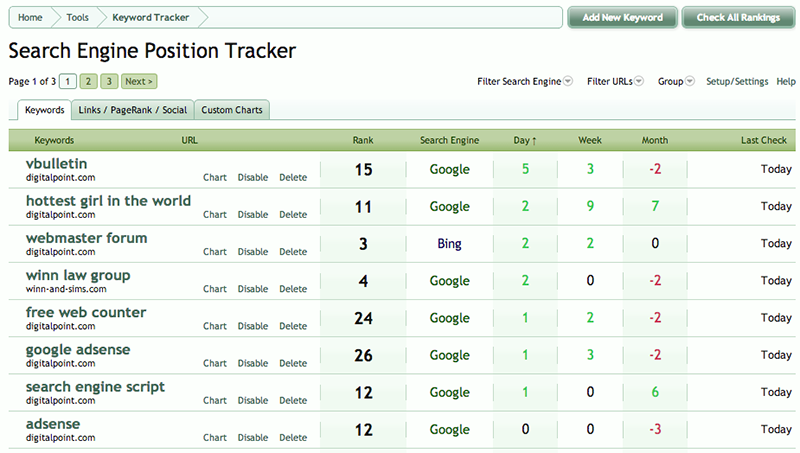
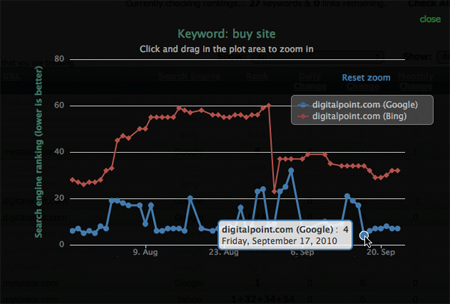
Click the chart icon to the left of whatever it is you wish to chart (for custom charts, click on the chart name), and be sure you aren't blocking pop-ups from digitalpoint.com. The icon you are looking for looks like: When you are looking at the chart, the button will allow you to see the raw data that the chart is being generated from.
Can I track how many documents are in my site?
Yes, the back link tracker will automatically keep track of that for you.
Can I track what my PageRank is?
Yes, also under the back link tracker, you can see PageRank historically for all the URLs you track back links for.
Can I see actual search results that are near my keywords or see how much competition I have?
Yes, under "Edit Preferences" you can set the 'Show Surrounding URLs On Manual Query' setting to 'Yes'. Then you will see it when you click on a keyword to do a manual query.
Why does the number of documents in a URL and/or the number of pages I'm competing with seem lower than it should?
That's a good question... As far as I can tell, Google's API is returning lower than normal results for whatever reason. It does seem to be relative though, so it does currently have some value. But hopefully the API will start returning more accurate values at some point. This does NOT affect the actual results or order of the results.
I have two results in on Google's search result within a single domain. Can you display both?
Yes, the keyword tracker will show (and track) both placements for you automatically.
What if my placement changes within a single date?
They keyword tracker will always use the best daily placement for its historical records.
Can you restrict search engine placement to a specific language and/or country (www.google.de for example)?
Yes you can. You can set your language and/or country restrictions by clicking on the 'Edit Preferences' link on the main screen. The country restriction is what the International versions of Google use by default.
Do you support keywords for Unicode (UTF-8) languages such as Japanese, Chinese or Russian?
Yes, completely. In fact, the "normal" Google API SOAP clients do not always return correct results for Chinese, Japanese or Korean, but since we wrote our own SOAP cleint from scratch, we were able to make some changes to it to assure it does always work for those (and all) languages.
English is not my primary language, can I use the system in other languages?
Yes, you can. We have designed a modular language system that makes adding new languages a very simple task. If there are languages you would like to add that are not already in the system (and you can translate them), email us and we can send you a translation sheet to get it added for you. If your language is already available, you can set the language on a per user basis under "Edit Preferences".
I'm getting an N/A (not available) ranking, but I know it should be in there.
Make sure your URL matches... are you entering http://www.yourdomain.com, but Google returns http://yourdomain.com for example? It does a simple pattern match, so if Google returns http://www.yourdomain.com/products/wigets/ for example, you could enter the URL in the keyword tool as the exact URL or something like: http://www.yourdomain.com or even just yourdomain.com.
Do I need to log into the system for it to check my keywords every day, or will it do it automatically?
You need to log in and click the 'Check All' button. It's not automated because there are a *ton* of users (remember how it's free?), and I don't think Google would be too stoked to have our server making hundreds of thousands of requests at the same time every night to update everyone's stats.
I'm going to be on vacation, but I still want the historical data for those days. Isn't there *anything* I can do to automate it?
Yes there is... if you are technically inclined, you can setup an automated process on your end to make an HTTP request for the 'Check All' button in your account. If you make an HTTP request of: http://login:password@www.digitalpoint.com/tools/keywords/?action=lookupall, it will trigger the check all action automatically. If you have access to a UNIX or Mac OS X machine with curl installed, you can make a cron job for it by adding the following to your /etc/crontab file:
xx yy * * * root curl "http://login:password@www.digitalpoint.com/tools/keywords/?action=lookupall"
where xx = minute of the day and yy = hour (in 24 hour format) you want it to run for you.
For Windows you can setup an Scheduled Task under your Control Panel. At the end of the config, choose to go to the advanced properties window and add a space and the above URL to your command (after the curl command).
And just to be nice to our servers (and Google), try to schedule it at a random time during the day, like the month of your birthdate for the hour and your age for the minutes.
How does it work?
Each user has a unique Google API key which is issued from Google. Calls are made on the backend using your key to Google via SOAP/XML calls. The system is coded with PHP and the backend database is MySQL 4.1. The SOAP client implementation was custom made (by us) specifically for this application (the existing SOAP clients are simply too slow or have problems in one form or another).For MSN and Yahoo queries, the requests are proxied through the end-users web server.
This thing is fast. Why is it faster than other products/services I've used?
A major focus was on long-term scalability and efficiency. The backend database schema is pretty much infinitely scaleable. Queries made to Google are done as efficiently as possible (other systems will start at the beginning of the search results and keep searching until it finds your entry, while ours will start at the last known position and branch out from there). Internally the "Check All" process is multi-threaded and will spin itself off into it's own thread. That thread can also be setup to run on different machines anywhere in the world if needed (at this point they run on the main server, but it's always good to be proactive in the design and plan ahead).
How many queries are you making to the Google API server with my API key?
The Google API is only able to return 10 results per query, so to lookup a single keyword placement, it can sometimes take more than one query. The N/A position keywords are the ones that really tear through the queries... As an example, an account that is setup to look 200 positions deep, and has 25 N/A position keywords will go through 500 (half of their daily allowed) queries just for those keywords. Keywords with no last known position (N/A rank), will take one query per 10 positions deep your account is setup to look. If a keyword has a last known position, and you are still within the grouping of 10 around it, it will find it with a single query (it starts looking at the last known position). Otherwise, the system will start at the last known position, and branch out from there with queries until it finds the new position (or it hits the limit of how deep you want it to look).
The lookup thread seems to be stuck, what can I do?
There are occations where your process that checks all your keywords and back links may get stuck (it appears to be when Google's API server is under heavy load). The easiest thing to do is simply click the "Check All" button again. When a check all thread is spawned, our system will see if you have any running threads already. If you do, the old thread is killed and the check all will pick up where that one left off.
I had a lower position, but now it's higher. Why does it still report the lower position?
The system attempts to make as efficient use of your Google API key as possible by searching at your last known position. Because of this, if your old position remains in its current place, but a new page in your domain ranks higher, it will stop searching for your rank after it locates the first one (which will be your last known position). To get around this, you can trigger the "Check All" function to run and search from the beginning of the results by clicking here.
I'm getting a rank, but it's different than what I see in Google myself.
The keyword tracker uses the Google API, so Google decides which data center for it to use (just as if a user goes to www.google.com). Google has a lot of things that determines what data center to use, but a big part of it is physical location as determined by IP address (Google wants to send traffic to the closest physical data center). Our servers are in Southern California, so Google routes to a data center based on the request coming from Southern California. What that means, is the keyword tracker is reporting the correct results, but from a different data center than you are being routed to (Google data centers are never 100% in synch), so some users *are* seeing the rankings being reported. It just depends on the data center Google is routing them to.
For international users, the difference is bigger. Google does geo-targeting based on the IP address of the end user, so users from one country will always see results that are different than another country (if you are in France for example, Google will give a higher weight to sites in French and websites physically located in France). If you use the advanced script, you can make the actual queries from any IP address in the world.
Can I have (or buy) a copy of this system so I can run it on my own server?
No, sorry... at this point we are not offering it as a product. Only as a free web-based service. Also, we will not make you a similar system that does not use the Google API (which for what it's worth would be a viloation of Google's terms of service), you would be amazed at how many requests for this we have received.
Will you add support for [insert your favorite search engine here]?
The keyword tracker supports Google, Yahoo and MSN at this point. Until there is another search engine with significant market share, it's probably not worth it.
I don't trust giving my Google API key to you.
Then don't. :) If we were trying to mine for Google API keys, I'm sure there would be much easier ways to do it than make a cool system like this. Your Google API key is not disclosed to anyone, nor is is used for anything other than the queries you make.
I have a question, problem or suggestion, can I contact you?
Sure, you can jump on the search engine forum and fire away in the keyword tracker section.